
Olga Neuwirth is one of the outstanding composers of our time and has written a new opera in collaboration with Nobel Prize winner, Elfriede Jelinek. As avatars of themselves, they send two vampires (Vampi & Bampi) on a trip around the world. They observe the decline of humanity, whilst a tyrannical king and his own pet sea monster vie for ultimate power. Monster's Paradise is a tragedy and satire at the same time. The director of the Hamburg State Opera, Tobias Kratzer, makes his Zurich Opera debut with this brand new political grotesque. Swiss conductor, Titus Engel, conducts the Zurich Opera and Ballet Orchestra.
Olga Neuwirth (*1968) — Monster’s Paradise (opera) (2025) on a libretto by Elfriede Jelinek and Olga Neuwirth
Titus Engel — conductor
Tobias Kratzer — director
Matthias Piro — scenic coach
Rainer Sellmaier — sets, wardrobe
Janic Bebi, Jonas Dahl — visual media
Michael Bauer — lighting design
Markus Noisternig — live electronics
Christopher Warmuth, Fabio Dietsche — dramaturgy
Vampi — Sarah Defrise
Vampi — Sylvie Rohrer
Bampi — Kristina Stanek
Bampi — Ruth Rosenfeld
Der König-Präsident — Georg Nigl
Der König-Präsident — Robin Adams (14th & 18th March)
Gorgonzilla — Anna Clementi
Mickey — Andrew Watts
Tuckey — Eric Jurenas
Ein Bär — Ruben Drole
++++++++++++++++++++++++++++++++++++++++++
Can a monster save the world…?
In Monster's Paradise, composer Olga Neuwirth has created a highly topical political grotesque for the opera stage, which we are presenting in co-production with the Hamburg State Opera. A conversation with its director, Tobias Kratzer:
Tobias, you recently said—somewhat exaggeratedly—that you only became Artistic Director so that you could commission a new music theatre work by Olga Neuwirth. Where does this enthusiasm come from?
I have been following Olga Neuwirth's work for many years and consider her one of the most important composers of our time. She manages to fuse high avant-garde with everything else that exists musically in our world into a unique amalgam. And she does so with a great deal of humour, which is not so common in contemporary music. Olga Neuwirth doesn’t create works that are easy to perform or consume, and I believe that is what distinguishes the works of great artists: they always look beyond the possibilities of their time and pepper them with a hint of un-performability. This task, which now faces us with ‘Monster's Paradise’, appeals to me as an artistic director and director because it challenges the further development of the operatic / music theatrical form itself.
Olga Neuwirth collaborated with Elfriede Jelinek on the libretto. What connects the two?
A long artistic friendship and collaboration. I believe Olga was sixteen when she met Elfriede. A few years later, she had already composed two successful miniature operas based on her texts. Elfriede's great admiration for Olga and her work has now contributed to her returning to writing opera libretti. She wrote a large collection of libretti, from which Olga then extracted the libretto with a view to setting it to music. Elfriede Jelinek is known for writing almost exclusively for the stage in the form of so-called ‘text surfaces’ with sparsely distributed roles. I therefore find it spectacular that in this case she has written a libretto that contains roles and dialogues in the classical sense. In addition, ‘Monster's Paradise’ is an original Jelinek work, whereas she had adapted existing material for Olga Neuwirth's earlier operas: a drama by Leonora Carrington for ‘Bählamms Fest’, or the screenplay for David Lynch's film for ‘Lost Highway’.
One of the main characters in ‘Monster's Paradise’ is a despotic king/president. How does this theme fit into Elfriede Jelinek's work?
‘Monster's Paradise’ ties in with the play ‘Am Königsweg’ (‘On the King’s road’), which Elfriede wrote in 2016 after Donald Trump was elected for his first term. Incidentally, Olga and Elfriede conceived and wrote the libretto for ‘Monster's Paradise’ before Trump was elected president for the second time. It’s a testament to the prophetic qualities of these two artists that they anticipated the current course of American and world history in so much detail. Trump's second election has made the work even more relevant. Nevertheless, both say – and we try to show this in the production – that it’s not a “piece about Trump”. Trump is interesting not as an individual, but as a symptom: as an exemplary case of a populist ruler, or of a form of government that, since the Enlightenment, would no longer have been considered possible in democratic states, if only in premature optimism. The fact that this kind of thing is making such a massive comeback internationally gives the play its acute topicality.
Due to the long planning and composition process, opera usually lags behind current political events...
If that’s the case, we have to hurry to ensure that reality does not catch up with our theatrical ideas! For the palace of the king/president, we took some inspiration from the Oval Office in the White House, which we decorated in gold. Indeed we had already designed this set before Trump began to gild his Oval Office at the start of his second term...
The work with the somewhat blockbuster-like title ‘Monster's Paradise’ is subtitled ‘a Grand Guignol Opéra’. What kind of world is this?
The genre designation ‘Grand Guignol’ refers to a ‘lowbrow’ genre present in 19th century France. It is actually a form of entertainment theatre featuring cruelty, blood and shock effects, but also a higher form of Punch-and-Judy-like theatre for adults. Today, this form is most commonly found in popular culture, in superhero or supernatural monster films, but less so on the theatre stage. Olga quotes this form in an ironic way to show that this is perhaps the only form with which one can still confront the irrationalities of today's world. If neither post-dramatic nor psychological theatre nor well-made plays can adequately grasp the world’s circumstances, this cultivated kind of Punch-and-Judy-like theatrical approach is perhaps the most appropriate. Musically, too, a revue- or cabaret-like feel brings with it a special mode of expression that is partly reminiscent of ballad singing and is essentially linked to the storytelling form of opera, which is the epitome of ‘high’ form. This renders the combination of these two genres a contradiction, but also a new genre or form entirely.
The aforementioned king/president encounters the sea monster Gorgonzilla, who is not a one-dimensional villain. How do you interpret this character’s role?
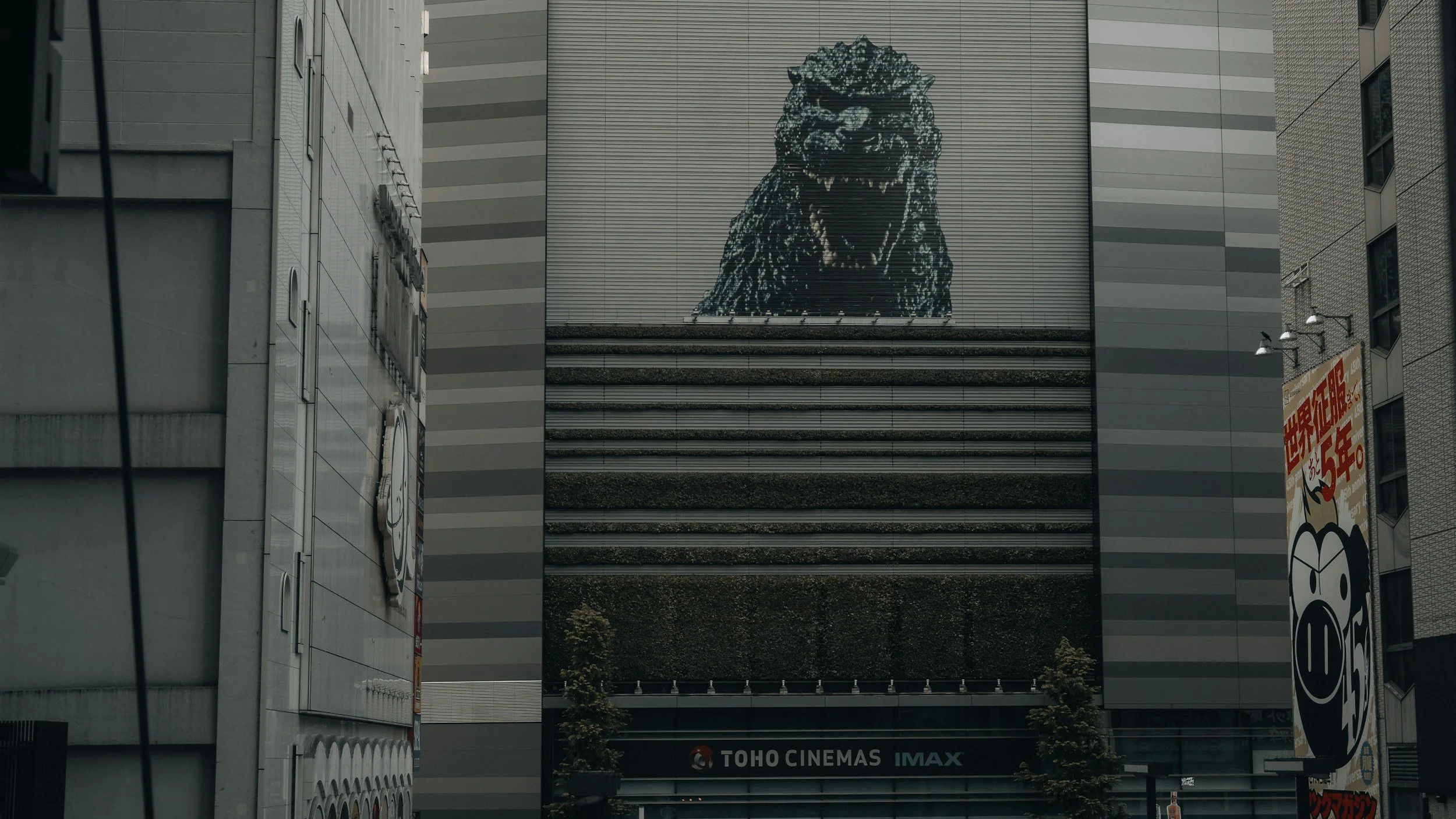
The monster is a highly ambivalent character. You never know exactly whose side they are on, whether they will save humanity from the tyrannical king or whether they are pursuing their own goals. Indeed the monster, Gorgonzilla, seems to be the only entity that can still fight against the real monsters of the world. So it can also be read as a symbol that any opposition must become monstrous per se in order to fight against a monster on the royal throne or in the presidential chair. On the other hand, the libretto also states that the monster was created by a reactor accident caused by the King/President... This dazzling ambivalence is already evident in the title: is ‘Paradise’ the island where the monster lives? Or is it now our world, where monsters feel as comfortable as they once did in their dragon caves? Incidentally, the voice of this character is also ambivalent, sung by a woman but electronically distorted to such an extent that it actually opens up a genderless soundscape.
Alongside a goddess, a bear and zombies, the two vampires Vampi and Bampi also roam this badly damaged world...
Olga and Elfriede not only created the work but they also appear in it as characters. I find that quite fascinating! Disguised as vampires, the two descend into the world and reflect on what they have achieved so far with their artistic endeavours. In-keeping with the nature of vampires, who have always been around but, by their very nature, cannot change much, the two have a fundamentally fatalistic view. Nevertheless, or more precisely, because it simply doesn't matter, they want to have another go, existing in this world. And that actually sums up the creative impulse of the artists quite well. This looking back on their own work makes the play very multi-layered. As a viewer, you are not only confronted with monster battles, but are also led by the hand through the world by the two vampires.
The subject matter of this new play is deeply political. However, provocation and scathing criticism do not seem to be the central themes. What does that mean for your production?
Monster's Paradise is loosely based on Alfred Jarry's play ‘King Ubu’, which is an example of absurdist theatre. For me, it's about using this grotesque form to reflect on our world, rather than provoking the audience. I believe that the era of provocation is over anyway. For many decades, so-called ‘regie theatre’ worked to deconstruct traditional opera culture. In the meantime, however, it has itself become the gold standard. As artistic director, I am therefore looking for interesting ways to offer not just another reinterpretation of a classic with every performance, but rather to create a kind of immediate sensuality by exploring rarely performed works, world premieres and a different approach to the repertoire.
Olga Neuwirth's score was completed shortly before rehearsals began and your staging concept was developed in parallel. How are you bringing the two together now?
It was important to me to give the staging and spatial concept a certain openness that would allow for playful improvisation during rehearsals. The exact sequences of movements are, of course, based on the score, which we are now also working on in collaboration with Olga. However, the libretto has been available for some time and has various levels: in its microstructure, it is—like the individual notes of the score—incredibly precise, cleverly collecting “Trump's verbal rubbish” and thus revealing the realities of his language. For the director, however, it is the macrostructure that is particularly interesting, in which the individual images actually take the form of parables that point beyond these details. As a director, I find it exciting to clearly convey this framework so that the great richness and the minute absurdity of the piece can unfold within it.
The monster, Gorgonzilla, ends the work with the line: “Freedom now appeals to me too!” This brings us very close to a classic opera trope...
I always say that Olga Neuwirth's operas represent our time in the same way that Beethoven's Fidelio represents the beginning of the 19th century. And indeed, ‘Monster's Paradise’ could be understood as a kind of dystopian rescue-opera in the tradition of Fidelio. However, it is not the monster who has the last word, but the music. His words are followed by a musical epilogue in which music by Franz Schubert is quoted played by a detuned piano, fading into the distance together with the two vampires. I think this is an important statement, that perhaps music lasts longer than human conflict.
Interviewer: Fabio Dietsche